
Not All Storage Is the Same: CFS, Ports, or Depots - What's Best for Your Containers?
In global freight logistics, the question of where to store your containers - and for how long - can significantly affect your total shipping costs, customs timelines, and overall supply chain efficiency. Yet many shippers, NVOCCs, and importers treat storage as an afterthought rather than a strategic decision.
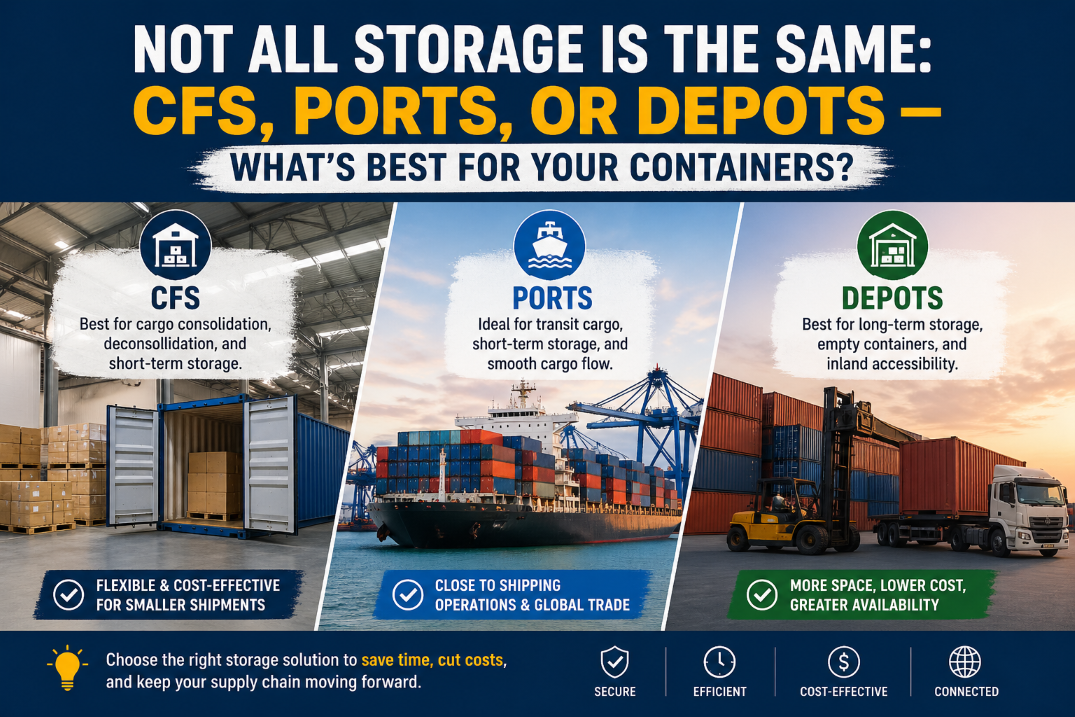
Three key options exist in the container supply chain: Container Freight Stations (CFS), port-based Container Yards (CY), and off-dock Container Depots. Each has a distinct purpose, cost structure, and operational profile. Choosing the wrong one can mean unnecessary demurrage charges, cargo delays, or missed vessel sailings.
1. Container Freight Station (CFS): The Consolidation Hub
What Is a CFS?
A Container Freight Station (CFS) is a facility — located either near a port, airport, or inland transport hub — where cargo is received, sorted, consolidated, and loaded into containers for onward shipping, or deconsolidated upon arrival for distribution to consignees.
CFS facilities operate under customs authority jurisdiction, regardless of whether they are privately owned or port-managed. They are primarily designed to handle Less-than-Container Load (LCL) shipments, though many modern CFS facilities also process Full Container Load (FCL) cargo.
Key Functions at a CFS
Consolidation: Combines cargo from multiple shippers into a single FCL container, reducing per-shipment freight costs.
Deconsolidation: Separates arriving FCL containers into individual LCL shipments for collection by respective consignees.
Customs clearance coordination: Handles documentation, inspections, and customs release procedures.
Short-term cargo storage: Provides a buffer for goods awaiting loading or pending customs clearance.
Container maintenance: Basic inspection, cleaning, and pest-proofing of containers.
Multimodal logistics support: Facilitates intermodal transport connections between sea, air, and rail modes.
When to Use a CFS
A CFS is ideal when your shipment volume does not fill an entire container (LCL), when you need customs-adjacent processing close to the port, or when you are managing multiple small consignments headed to the same destination. It is particularly suited to importers and exporters in international trade who ship in irregular quantities.
CFS Cost Considerations
CFS charges typically include handling fees for consolidation and deconsolidation, customs documentation fees, short-term storage, and trucking from the port to the CFS. While per-unit handling costs are higher than at a Container Yard (because cargo is unpacked and sorted), the overall cost for LCL shippers is usually lower since you only pay for the container space you actually use — making it an important tool for freight cost optimization.
2. Port-Based Container Yard (CY): Speed and Direct Access
What Is a Container Yard?
Container Yard (CY) is a designated storage area within a port or terminal where full, sealed containers are stored temporarily — either before loading onto a vessel for export, or after discharge while awaiting collection. It is operated by the port authority or terminal operator and is the default endpoint for FCL shipments.
Unlike a CFS, a CY does not handle cargo stuffing, consolidation, or customs documentation as primary functions. Its role is physical storage, container handling, and transfer — making it a critical node in port automation and container handling operations globally.
Key Functions at a Port CY
FCL storage: Holds sealed full container loads awaiting vessel loading or consignee pickup.
Empty container storage: Stacks empty containers returned by shipping lines or leasing companies.
Container tracking and monitoring: Maintains records of container gate-in and gate-out times.
Loading and discharge coordination: Directly interfaces with vessel operations and terminal equipment.
TEU capacity management: Manages throughput and TEU capacity and efficiency at terminal level.
When to Use Port Storage
Port storage is the standard choice for FCL shipments where cargo has been stuffed and sealed at origin and requires minimal handling at the port. It is also used for containers in transit, waiting for the next vessel connection. It is best when turnaround times are tight and the container needs to be as close as possible to the berth for loading.
Cost and Demurrage Risk
Port storage is subject to demurrage charges if containers remain beyond the carrier's free-time allowance (typically 3–7 days, depending on the port and shipping line). At busy international ports, demurrage and detention fees can accumulate rapidly. This makes careful scheduling and container tracking and monitoring essential when relying on port storage. Moving containers to an off-dock facility once free time is nearing expiry is a widely used strategy to avoid escalating port charges.
3. Container Depot (Off-Dock): Flexibility and Lower Costs
What Is a Container Depot?
A container depot is a storage and maintenance facility, typically located inland or just outside port premises (off-dock), that specialises in holding empty containers, conducting repairs, and facilitating container fleet management. Depots are commonly used by shipping lines, container leasing companies, and NVOCCs to manage their equipment inventory between shipments.
Depots are sometimes referred to as Container Service Depots (CSD), Off-Dock Yards, or — when located deep inland — Inland Container Depots (ICD) or dry ports. ICDs function similarly to seaports for hinterland regions, receiving and dispatching containers by road or rail as part of containerized rail freight and domestic container transport networks.
Key Functions at a Container Depot
Empty container storage: Primary function — stores empty boxes on behalf of shipping lines and leasing companies.
Container repair and maintenance (M&R): Inspects, surveys, and repairs containers to IICL or CW standards before reuse.
Container repositioning: Manages the movement of empty containers to deficit areas where export demand exceeds supply.
Container trading: Acts as a marketplace where off-hire or surplus containers can be bought and sold; conditions are categorised as New/One-Trip, IICL/Cargo Worthy, or Wind and Watertight (WWT).
Demurrage avoidance: Allows containers to be gated out of port before free time expires, stopping the demurrage clock at a lower daily storage rate.
Stuffing and de-stuffing support: Some depots provide container stuffing facilities for exporters near their factories or distribution centres.
When to Use a Container Depot
Depots are the go-to choice when storing empty containers for extended periods, when containers need maintenance between leases or voyages, and when shippers want to avoid port congestion and demurrage costs. For container leasing companies and NVOCCs managing a container fleet, depot relationships are central to efficient container fleet management and freight cost optimization.
Depot Cost Structure
Depot charges are structured around a Gate-In/Gate-Out (handling) fee plus a daily storage rate per TEU. Storage costs at a depot are significantly lower than port terminal rates. Long-term storage arrangements can often be negotiated at flat monthly rates. When evaluating a depot, it is advisable to review the M&R tariff transparency and confirm adherence to IICL repair standards to avoid overpayment on repairs.
How to Choose the Right Option for Your Cargo
The right choice depends on your cargo type, volume, timeline, and cost priorities. Here is a practical framework:
Choose a CFS if:
Your shipment is LCL — you do not have enough cargo to fill a container.
You are shipping to or from a location where consolidation with other cargo makes economic sense.
You need customs-adjacent handling and documentation support near the port.
You are involved in multimodal logistics where cargo transitions between sea, air, or rail.
Choose Port Storage (CY) if:
You are shipping FCL and need the container as close to the vessel as possible.
Your turnaround is fast and the container will be collected or loaded within the free-time window.
You are managing time-critical shipments where proximity to the berth is essential.
Choose a Container Depot if:
You need to store empty containers for extended periods at lower cost.
Containers require inspection, cleaning, or repair before their next use.
You want to stop the demurrage clock by moving containers off-port before free time expires.
You are involved in container buying and selling or container fleet management.
You are a container leasing company managing repositioning of empty equipment.
Conclusion
CFS, port container yards, and off-dock depots each play a distinct and irreplaceable role in the container supply chain. Treating them as interchangeable can lead to unnecessary costs, delays, and compliance risks. By understanding the purpose and cost structure of each option, shippers, NVOCCs, freight forwarders, and container leasing companies can make decisions that genuinely optimise their containerized cargo management and overall supply chain efficiency.
For expert guidance on container leasing, container fleet management, or navigating storage options for your specific trade lanes, reach out to the VS&B Containers Group team today.
VS&B Containers group offers both standard and custom-made containers, delivered directly from the factory to your desired location. With a fleet of over 25,000 containers made available across Asia, Europe, US and Australia, the company helps customers get containers effortlessly from anywhere in the world. If you have unique needs in terms of affordability, adaptability, and potential return on investment, please drop an email to traders@vsnb.com, and the VS&B team will contact you to discuss further.
- Log in to post comments