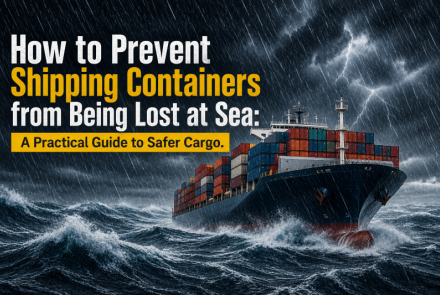

How to Prevent Shipping Containers from Being Lost at Sea: A Practical Guide to Safer Cargo
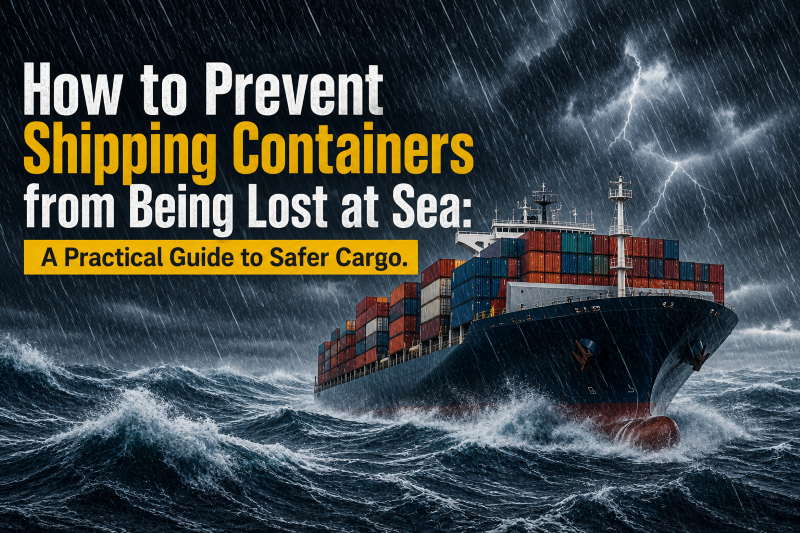
Every year, thousands of shipping containers go overboard - some in headline-making storms, most in a quiet trickle that barely makes the news. With mandatory loss reporting now in effect as of 2026, the industry is finally getting a clearer picture of the problem. But better counting only gets you so far. The real question for carriers, shippers, and logistics partners is simpler: what actually stops a container from falling in the first place?
The good news is that container loss isn't purely a matter of bad luck or unavoidable weather. Most incidents trace back to a handful of preventable failure points - and the industry has spent years developing the technology, standards, and practices to address each one.
1. Accurate Weight Declarations and Verified Gross Mass
One of the least visible causes of container loss is also one of the most fixable: bad paperwork. Every container loaded onto a ship comes with a declared weight, and stowage plans depend on that number being accurate - heavy containers are supposed to sit at the bottom of a stack, lighter ones on top. But carriers can't physically open and re-weigh every sealed box, so the entire stacking plan runs on trust in the declared figures.
That trust is often misplaced. Inspection studies have found significant rates of documentation and safety problems in containers declared as carrying dangerous goods, and inaccurate weight declarations are a recurring theme in incident investigations. A stack built around a falsely light "heavy" container can hold up fine in calm seas - and fail catastrophically the moment a storm puts real stress on it.
What helps: Strict enforcement of Verified Gross Mass (VGM) requirements, spot-check weighing programs at ports, and treating weight documentation with the same rigor as hazardous materials declarations. This is one of the simplest, lowest-cost improvements available to the industry, and it directly supports better container security and safety across the board.
2. Smarter Stowage and Stacking Practices
Even with accurate weights, how a ship is loaded matters enormously. Poor stowage planning concentrates risk in exactly the wrong places - tall, top-heavy stacks in positions on deck that experience the most motion during rough weather.
Research programs studying container stack failures - including detailed work on how and why lashings fail under stress - have fed directly into updated stowage guidelines. These focus on distributing weight more conservatively, limiting stack heights in high-risk deck positions, and accounting for a ship's specific rolling characteristics rather than applying one-size-fits-all loading rules.
What helps: Stowage software that models a vessel's actual motion response, more conservative stacking limits on outer and upper deck positions, and stronger integration between stowage planning and container fleet management systems so loading decisions reflect real vessel behavior, not just available space.
3. Better Lashing Systems
Lashings - the equipment that physically secures containers to the deck and to each other - are the last line of defence once a ship starts rolling. When they fail, entire stacks can peel off in minutes.
Industry research initiatives have spent years studying exactly how and why lashings give way under extreme conditions, particularly during parametric rolling, a phenomenon where a ship's rolling motion becomes self-reinforcing and can reach 30 to 40 degrees within minutes. That research has directly shaped newer lashing standards, stronger twist-lock designs, and revised guidance on how lashing equipment should be inspected and maintained.
What helps: Adopting updated lashing standards as they're published, routine inspection and replacement of lashing equipment showing wear, and training crews specifically on the failure patterns identified in recent research - not just generic securing procedures.
4. Weather Routing and Avoidance Technology
Not every storm is unavoidable, and not every dangerous sea state looks dangerous from a distance. Parametric rolling in particular occurs under a fairly specific combination of wave length, wave period, and ship speed - conditions that can sometimes be predicted and avoided before a vessel ever enters them.
Weather routing technology has improved significantly, giving ships better tools to identify and steer around the exact conditions most likely to trigger dangerous rolling, rather than simply avoiding storms in general. This is a meaningful shift from reactive seamanship to predictive risk avoidance.
What helps: Investment in advanced routing software integrated with real-time ocean and weather data, and giving ship masters the authority and support to alter course proactively rather than holding a schedule through borderline conditions - a decision that also supports long-term freight cost optimization, since a lost container is far more expensive than a delayed one.
5. Regulatory Accountability
Prevention isn't only a matter of equipment and technique - it's also a matter of incentives. For decades, container loss reporting was largely voluntary, which meant there was limited external pressure to invest in prevention beyond what individual carriers chose to do.
The IMO's new mandatory reporting requirements, in effect as of 2026, change that dynamic. When every lost container must be officially declared, loss rates become visible, comparable, and harder to treat as an acceptable cost of doing business. That transparency creates real pressure - reputational and regulatory - to invest in the prevention measures above.
What helps: Carriers and logistics partners that get ahead of this shift, rather than treating it purely as compliance overhead, will be better positioned as customers increasingly factor safety performance into who they choose to ship with.
6. Real-Time Tracking and Monitoring
Even with the best prevention measures, some containers will still be lost. When that happens, the difference between a quick recovery and a container that disappears for good often comes down to visibility.
Modern container tracking and monitoring technology - GPS-enabled tags, IoT sensors, and integration with port automation and container handling systems - makes it possible to know a container's last known position with far more precision than in the past. That doesn't just support faster physical recovery; it also feeds better data back into the industry's understanding of where and why losses happen, strengthening every other item on this list over time.
What helps: Broader adoption of tracking-enabled containers across a fleet, not just high-value cargo, and treating the resulting data as an input to safety planning rather than a recovery tool alone.
Conclusion
Container loss will probably never reach zero - as long as massive volumes of cargo move through the ocean's roughest weather, some risk will always remain. But "probably never zero" is very different from "largely unpreventable." Nearly every failure point in this list - bad weight paperwork, poor stowage, aging lashings, avoidable weather exposure, and blind spots in tracking - is something the industry can actively address, and in many cases already has the tools to fix.
For carriers, shippers, and logistics partners, the path forward is less about waiting for the next regulation and more about treating prevention as a competitive advantage. Investing in accurate documentation, modern lashing standards, predictive routing, and reliable container tracking and monitoring isn't just about avoiding losses - it's about building the kind of container supply chain that customers can trust with confidence.
At VS&B Containers Group, that's the standard we hold ourselves to: durable, well-maintained equipment, rigorous safety practices, and the kind of container security and safety measures that keep cargo where it belongs - on the ship, and on schedule.
VS&B Containers group offers both standard and custom-made containers, delivered directly from the factory to your desired location. With a fleet of over 25,000 containers made available across Asia, Europe, US and Australia, the company helps customers get containers effortlessly from anywhere in the world. If you have unique needs in terms of affordability, adaptability, and potential return on investment, please drop an email to traders@vsnb.com, and the VS&B team will contact you to discuss further.
- Log in to post comments