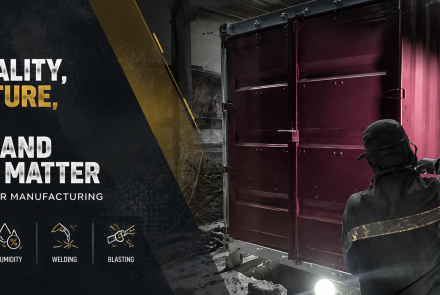

Why Paint Quality, Temperature, Humidity, Welding and Blasting Matter in Shipping Container Manufacturing
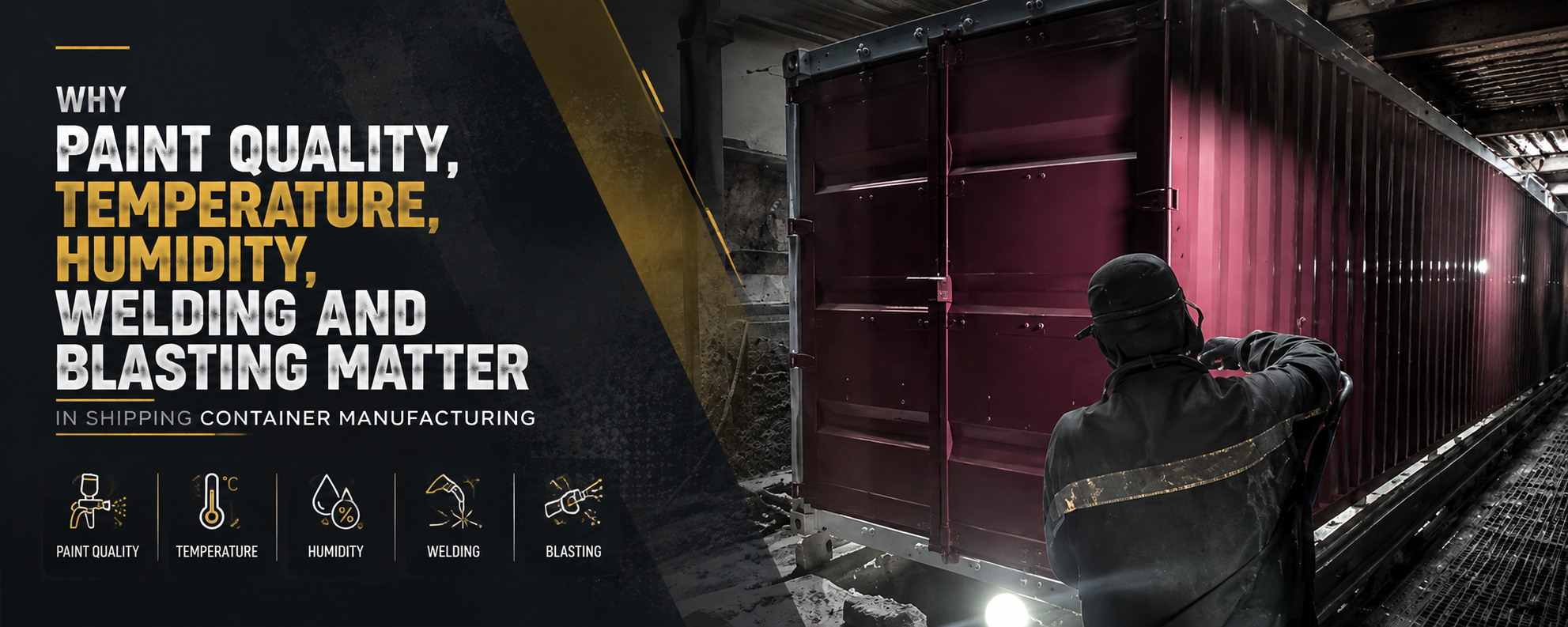
A shipping container can have high-quality steel and a strong structural design, but that alone does not guarantee long service life.
The quality of the manufacturing process is critical.
From welding and surface preparation to paint selection and environmental conditions during coating application, several stages determine how well a container will perform after it leaves the factory.
This is particularly important because shipping containers are exposed to demanding environments. They can spend years moving through ports, ships, roads and railways while being exposed to rain, humidity, salt-laden air, UV radiation, temperature changes and repeated handling.
That is why proper welding, blasting, paint quality, temperature and humidity control are important considerations in shipping container manufacturing.
1. Why Is Welding Quality Important?

Welding joins many of the steel components that form a container's structure.
The container frame includes components such as corner posts, rails, cross-members and other structural members. Welding must create reliable joints so that the assembled structure can withstand the loads and stresses expected during handling and transportation.
Poor welding can introduce imperfections that may reduce the quality or performance of a joint.
International welding standards recognize the importance of controlling weld imperfections. ISO 5817:2023 specifies quality levels for imperfections in fusion-welded joints and identifies three quality levels—B, C and D—with Level B representing the highest requirement on the finished weld.
The applicable quality level, however, depends on the design, specification and intended application. We should therefore not assume that every container weld must meet the same quality level.
What Can Happen When Welding Quality Is Poor?
Depending on the joint and service conditions, welding imperfections can contribute to problems such as:
- Inadequate joint integrity
- Local cracking or discontinuities
- Reduced load-carrying performance
- Increased vulnerability to corrosion at poorly finished areas
- Rework and manufacturing defects
The objective is not simply to make the weld look neat. The weld needs to satisfy the relevant engineering and quality requirements.
Welder qualification is also an important part of controlled welding production. ISO 9606-1 specifies requirements for qualification testing of welders performing fusion welding of steels.
2. Why Is Blasting Important Before Painting?
Before a protective coating is applied, the steel surface needs to be properly prepared.
Abrasive blasting is one method used to prepare steel surfaces for coating. It can remove contaminants, rust, mill scale and other surface conditions that can interfere with coating performance.
It also creates a suitable surface profile that can help the coating establish mechanical adhesion to the steel.
ISO 8501-1 provides preparation grades for steel surfaces and covers preparation methods including blast-cleaning.
The exact blasting specification—including the required preparation grade and surface profile—should be defined by the applicable coating system, project specification and manufacturer requirements.
Why Is Surface Preparation So Important?
Imagine applying a high-quality coating to a steel surface that still contains contaminants or poorly prepared areas.
The coating may not bond or perform as intended.
A coating system can only perform properly when the underlying surface has been prepared to the required condition.
This is why blasting and painting are not independent processes. Surface preparation is part of the overall corrosion-protection system.
3. Why Does Paint Quality Matter?

The paint on a shipping container is not simply there to make the container look attractive.
The coating forms an important barrier between the steel substrate and the surrounding environment.
A suitable protective coating system helps reduce the exposure of steel to moisture and other environmental factors that contribute to corrosion.
The appropriate coating system depends on factors such as the environment, expected exposure, substrate, application conditions and required durability.
ISO 12944 addresses corrosion protection of steel structures by protective paint systems. Its different parts cover subjects including environmental corrosivity, coating systems, specifications, laboratory testing and execution of paint work.
Therefore, "good paint" does not simply mean choosing the most expensive paint.
It means selecting an appropriate coating system for the intended service conditions and applying it correctly.
4. Why Do Temperature and Humidity Matter During Painting?
This is one of the most important—and frequently misunderstood—parts of coating application.
Paint does not cure and perform independently of its surroundings.
Air temperature, steel temperature, relative humidity and dew point can all affect coating application.
If the steel surface is sufficiently close to the dew point, moisture can condense on the surface. Applying a coating over condensation can interfere with adhesion and contribute to coating defects or premature corrosion.
ISO 8502-4 specifically provides guidance for estimating the probability of condensation before paint application and determining whether environmental conditions are suitable for painting.
There Is No Single Universal Temperature or Humidity Number
It is tempting to say that painting should always be performed at one particular temperature or below one particular humidity level.
That would be misleading.
Different coating products have different application and curing requirements. The correct limits should come from the coating manufacturer's technical data sheet and the applicable coating specification.
For this reason, professional coating operations monitor conditions such as:
- Ambient temperature
- Relative humidity
- Steel surface temperature
- Dew point
- Coating temperature where relevant
- Recoat intervals
- Ventilation and curing conditions
A commonly used industry practice is to maintain a sufficient difference between steel temperature and dew point to reduce the risk of condensation, but the exact requirement should always be confirmed against the applicable coating specification.
5. Why Is Dew Point Important?
Dew point is the temperature at which air becomes saturated and condensation can begin to form.
For coating operations, the important comparison is between the steel surface temperature and the dew point.
For example, air may feel dry to a person standing inside a manufacturing facility, while the steel surface itself may be cold enough for condensation to occur.
That is why simply checking room temperature is not enough.
ISO 8502-4 specifically describes using air temperature and relative humidity to estimate dew point and assess the likelihood of condensation on the surface to be painted.
6. What Happens If Paint Is Applied Under Unsuitable Conditions?
If coating is applied when the surface is contaminated, wet or otherwise outside the coating manufacturer's specified conditions, the coating may not perform as intended.
Possible problems can include:
- Poor adhesion
- Blistering
- Uneven curing
- Coating defects
- Reduced durability
- Premature corrosion
- Increased maintenance requirements
This does not mean that every coating defect is caused by temperature or humidity. Coating performance depends on the entire system, including surface preparation, material selection, mixing, application method, film thickness, curing and environmental conditions.
7. Why Is Coating Thickness Important?
The quality of paint is not determined only by its chemical formulation.
The amount of coating applied also matters.
A coating specification can define a required dry film thickness (DFT) or other inspection criteria. If too little coating is applied, the protective system may not achieve its intended performance. Excessive coating thickness can also create problems depending on the coating system.
Consequently, coating inspection may involve checking the applied film thickness and the condition of the finished surface.
The coating system should be applied according to the manufacturer's instructions, including mixing ratios, application method, recoat intervals and curing requirements.
8. Why Must Welded Areas Receive Attention During Painting?
Welding changes the surface condition of the steel.
Welds can contain spatter, sharp edges, irregular profiles and heat-affected areas. These areas may require appropriate cleaning, preparation and coating treatment before the final protective system is completed.
A good coating specification therefore considers not just large flat steel panels but also:
- Welds
- Edges
- Corners
- Joints
- Drainage areas
- Difficult-to-reach locations
- Areas affected by fabrication
ISO 12944-3 addresses design considerations intended to help avoid premature corrosion and degradation of protective coatings or the steel structure, including design measures that facilitate coating application, inspection and maintenance.
9. Why Do These Processes Need to Work Together?
A shipping container's corrosion protection should be viewed as a chain:
Quality steel → Correct fabrication → Quality welding → Proper surface preparation → Suitable coating system → Controlled application → Inspection → Maintenance
If one link is weak, the overall result can be affected.
For example, excellent paint cannot compensate for badly prepared steel underneath it. Similarly, perfect surface preparation cannot compensate for a coating system that is unsuitable for the intended environment or applied outside its specified conditions.
This is why manufacturing quality needs to be controlled throughout the process rather than only inspected at the end.
10. How Does This Affect Shipping Container Durability?
Containers are working assets within the container supply chain.
They may be leased, traded, transported internationally, stored at depots and repeatedly handled at ports.
A well-manufactured container can support reliable intermodal transport, containerized rail freight, road transport and ocean transportation.
Good corrosion protection can also reduce the likelihood of premature deterioration and help protect the value of equipment used in shipping container leasing, container buying and selling, and container fleet management.
For operators managing large fleets, consistent manufacturing quality can therefore contribute to long-term asset performance and potentially reduce avoidable repair and maintenance requirements.
Manufacturing Quality Supports More Than Appearance
A new container's clean paint finish may be the first thing people notice, but appearance is only one part of manufacturing quality.
Behind that finish are several technical steps:
- Steel selection
- Accurate fabrication
- Controlled welding
- Surface preparation
- Appropriate blasting
- Suitable coating selection
- Environmental monitoring
- Correct coating application
- Inspection and quality control
These processes work together to produce a container capable of operating in demanding logistics environments.
Conclusion
A shipping container's quality is determined by much more than how it looks when it leaves the factory. From welding and blasting to paint quality, surface preparation, temperature, humidity and coating application, each stage plays an important role in the container's overall durability and performance.
Properly controlled manufacturing processes help create containers that are better prepared for the demanding conditions of international transportation, repeated handling and long-term use.
At VS&B Containers Group, quality and reliability are central to the container solutions we provide. Our experience across shipping container leasing, container buying and selling, container fleet management and specialized shipping containers enables us to support customers across a wide range of logistics requirements.
Because a container is more than a steel box—it is an essential part of the container supply chain. The quality built into that container can make a difference throughout its working life.
VS&B Containers Group — quality containers. Reliable solutions. Global reach.
VS&B Containers group offers both standard and custom-made containers, delivered directly from the factory to your desired location. With a fleet of over 25,000 containers made available across Asia, Europe, US and Australia, the company helps customers get containers effortlessly from anywhere in the world. If you have unique needs in terms of affordability, adaptability, and potential return on investment, please drop an email to traders@vsnb.com, and the VS&B team will contact you to discuss further.
- Log in to post comments