
Why Are Shipping Containers Corrugated and Made from Corten Steel?
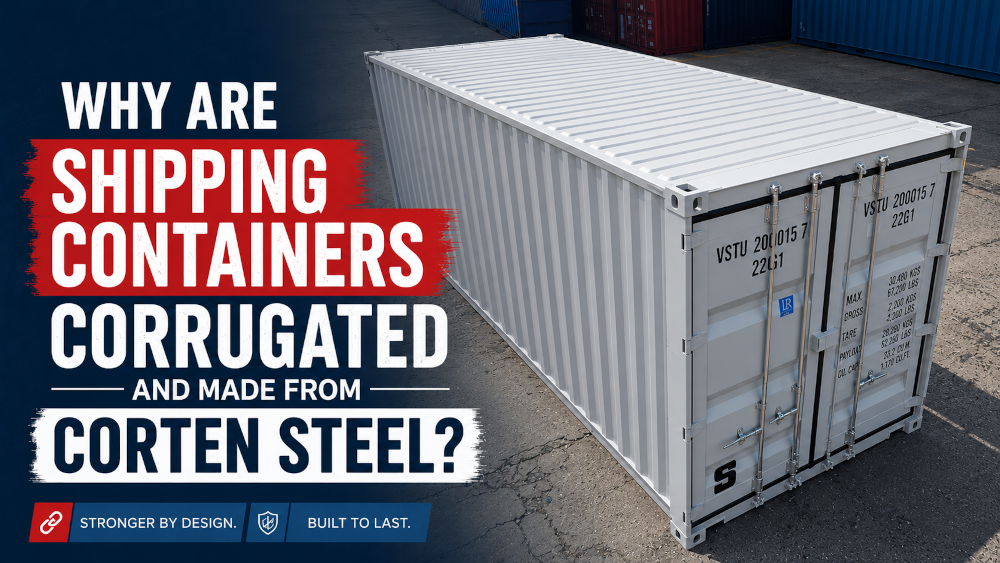
A shipping container may look like a simple steel box, but its construction is carefully engineered for a demanding job. A container can be exposed to salt-laden marine air, rain, temperature changes, repeated lifting, road and rail movement, cargo loads, and the forces generated when containers are stacked on ships and at terminals.
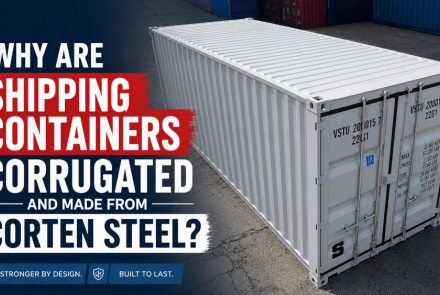
Two features are particularly noticeable on a conventional dry freight container: its corrugated steel panels and the use of weathering steel, commonly referred to as Corten steel, in many container designs.
So, why are shipping containers corrugated? And why is weathering steel widely used in their construction?
The answer comes down to a combination of structural performance, durability, weight, manufacturability, and the demanding conditions of international transport.
Why Are Shipping Containers Corrugated?
The side walls and, depending on the design, other panels of a container are formed with a series of ridges and valleys rather than being completely flat.
This corrugated profile increases the panel's stiffness without requiring the sheet to be made substantially thicker. In simple terms, changing the geometry of a thin steel sheet can make it considerably more resistant to bending and deformation than an equivalent flat sheet.
This is an important engineering principle for shipping containers because the container needs to remain structurally stable while keeping its tare weight under control.

Corrugation Provides Greater Stiffness
A flat sheet can flex relatively easily when subjected to forces perpendicular to its surface. The folds in a corrugated panel change the way the sheet resists those forces.
The resulting profile provides greater rigidity and helps the panel maintain its shape during handling and transportation.
For a shipping container, this matters because the walls can experience forces from several directions during their service life. Containers are lifted using their corner fittings, transported on road chassis and rail wagons, positioned in container-handling equipment, and stacked in terminals and aboard ships.
The corrugated panels work together with the container's structural frame, including the corner posts, top and bottom rails, cross-members, and corner castings. The container is therefore not dependent on the corrugated wall panels alone for its overall structural strength.
ISO 1496-1 specifies basic requirements and testing for ISO Series 1 general-purpose freight containers intended for international interchange and transport by road, rail and sea.
Corrugation Helps Achieve a Useful Strength-to-Weight Balance
One of the key objectives in container engineering is to obtain sufficient structural performance without unnecessarily increasing the container's tare weight.
Using a formed profile allows manufacturers to achieve useful panel stiffness while working with relatively thin steel sheets compared with what might be required for a completely flat panel of equivalent dimensions.
This contributes to efficient TEU capacity and efficiency, because reducing unnecessary container weight can help operators manage payload and transport economics.
However, it is important to distinguish between panel stiffness and the complete structural strength of a container. The corrugated panels are one part of a larger engineered structure.
Why Is Weathering Steel, Commonly Called Corten Steel, Used?
Many conventional shipping containers use weathering steel because it offers a useful combination of strength and atmospheric corrosion resistance.
"Corten" is commonly used as a generic industry term for weathering steel, although Corten is a trademark associated with specific weathering-steel products. Weathering steel is designed to develop an adherent oxide layer under suitable atmospheric exposure conditions.
This protective patina can slow further atmospheric corrosion compared with ordinary carbon steel under appropriate conditions.
Weathering steel is used in many applications where steel is exposed to the atmosphere, including containers and other structures. ArcelorMittal, for example, describes weathering steel as a self-protecting steel that develops a protective patina over time and lists containers among its applications.
Does Corten Steel Mean a Container Does Not Need Paint?
No.
This is an important point.
A shipping container made with weathering steel is still normally protected with a coating system. Weathering steel should not be interpreted as "rust-proof" or as steel that can be left untreated in every environment.
The performance of weathering steel depends on the environment and exposure conditions. Persistent moisture, salt exposure and other aggressive conditions can affect corrosion behaviour. Containers are frequently exposed to marine and coastal environments, so a suitable protective coating remains an important part of container durability.
The coating system provides an additional barrier between the steel and the surrounding environment.
Why Is Corrosion Resistance So Important for Shipping Containers?
A shipping container is a long-term logistics asset. It may move through several countries and climate zones during its service life.
A single container can experience:
- High humidity
- Rain and condensation
- Coastal and marine atmospheres
- Salt exposure
- UV radiation
- Temperature fluctuations
- Mechanical handling
- Road and rail vibration
- Repeated loading and unloading
Corrosion can eventually affect steel thickness, weld areas, door components and other parts of the container if it is not properly controlled.
This is why shipping container durability depends on more than just the choice of steel. Material quality, fabrication, welding, surface preparation, coating selection, coating application, inspection and maintenance all contribute to long-term performance.
Why Not Simply Use Much Thicker Steel?
Using thicker steel throughout the container could increase material use and weight without necessarily being the most efficient solution.
Container engineering aims to balance:
Strength + stiffness + durability + weight + manufacturing efficiency.
The corrugated panel design helps provide the required rigidity while the structural frame carries important loads. Weathering steel contributes corrosion resistance and suitable mechanical properties.
Together, these features make the conventional steel container practical for intermodal transport, where the same cargo unit can move between ships, trucks and trains without unloading the cargo itself.
Corrugation Is More Than an Appearance
The familiar ridged appearance of a container is therefore not simply a design choice.
The corrugations are an engineering feature.
They help increase panel stiffness, control deformation and contribute to a practical strength-to-weight balance. They also allow the container to use formed steel panels as part of a larger structural system.
This is one reason the familiar corrugated container has remained fundamental to global freight logistics for decades.
How These Features Support Modern Logistics
A container needs to perform reliably as part of the wider container supply chain.
Whether it is being used for containerized rail freight, road transport, ocean transport or temporary storage, the container must maintain its structural integrity and protect the cargo.
The same principle applies across different equipment categories. High cube containers (40’HC, 45’HC, 20’HC), specialized shipping containers and other ISO equipment are engineered according to their intended applications and applicable specifications.
For operators involved in shipping container leasing, container buying and selling, and container fleet management, understanding the construction of a container helps explain why material quality and condition are important when evaluating equipment.
The Bigger Picture: Engineering Behind a Simple Box
A shipping container may appear straightforward, but its design represents decades of engineering and standardization.
The corrugated panels provide useful stiffness. The structural frame provides the primary load-bearing framework. Weathering steel can provide atmospheric corrosion resistance when used appropriately, while protective coatings add another important layer of corrosion protection.
These features work together to create a durable transport unit capable of supporting international trade.
That is why the familiar corrugated steel box is much more than a simple storage enclosure. It is an engineered component of modern container shipping solutions, designed to work across ships, roads, railways and terminals around the world.
Conclusion
The corrugated walls and weathering steel used in shipping containers are not simply design choices—they are part of the engineering that enables containers to withstand the demands of global transportation.
From structural strength and durability to corrosion protection and efficient handling, every element contributes to a container's performance throughout its service life.
At VS&B Containers Group, we understand the importance of quality, durability and reliability in container solutions. With our expertise in shipping container leasing, container buying and selling, container fleet management and specialized container solutions, we provide equipment designed to support the diverse requirements of modern logistics and international trade.
Whether for intermodal transport, domestic container transport or global freight logistics, choosing the right container is an important part of maintaining an efficient and reliable container supply chain.
VS&B Containers Group — delivering reliable container solutions for a connected world.
VS&B Containers group offers both standard and custom-made containers, delivered directly from the factory to your desired location. With a fleet of over 25,000 containers made available across Asia, Europe, US and Australia, the company helps customers get containers effortlessly from anywhere in the world. If you have unique needs in terms of affordability, adaptability, and potential return on investment, please drop an email to traders@vsnb.com, and the VS&B team will contact you to discuss further.
- Log in to post comments