
Why Freight Forwarders and Container Providers Share a Symbiotic Role in Global Logistics
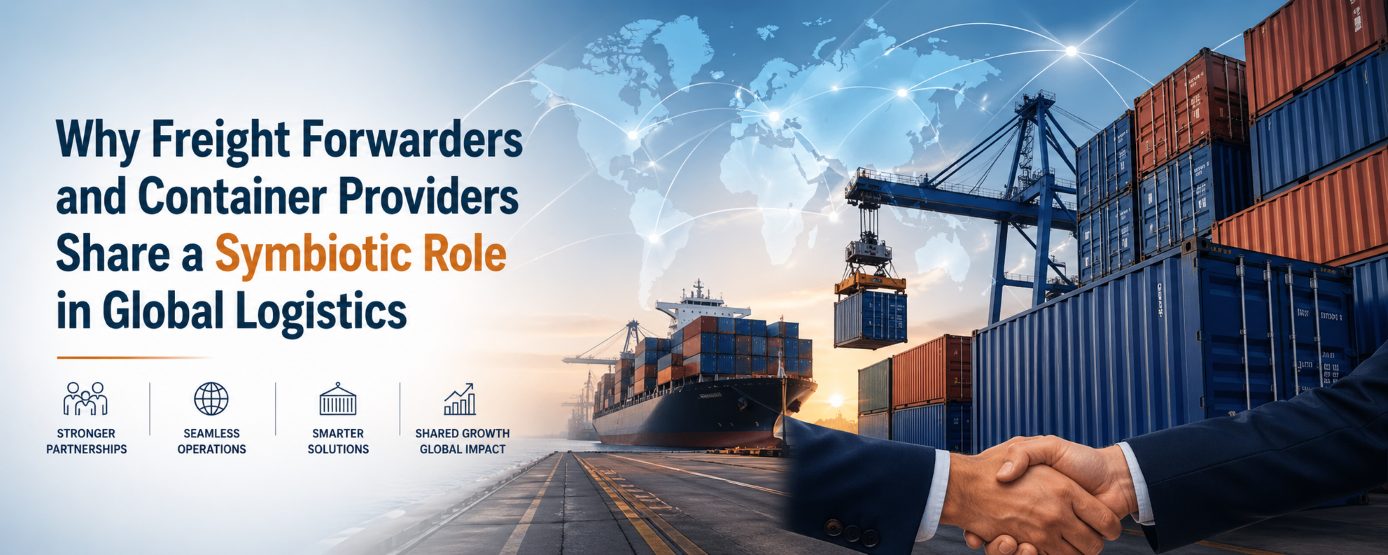
In the world of global freight logistics, no single player operates in isolation. The movement of goods across continents depends on a carefully coordinated ecosystem of service providers - and at the heart of this ecosystem lies a critical partnership: the relationship between freight forwarders and container providers.
Whether it is a 20-foot standard dry container crossing the Indian Ocean or a reefer container carrying temperature-sensitive pharmaceuticals from Europe to Southeast Asia, this collaboration underpins nearly every international trade shipment in the world today.
Understanding the Two Roles
A freight forwarder is an intermediary that organizes the shipment of goods on behalf of importers and exporters by coordinating with multiple parties such as shipping lines, airlines, truckers, customs brokers, and container providers, without typically owning the vessels or containers themselves. A container provider, on the other hand, is a company that owns, manages, leases, or sells shipping containers, playing a key role in container fleet management by ensuring the right equipment is available at the right place and time.
The Interconnection: Where Freight Forwarders and Container Providers Meet
The relationship between freight forwarders and container providers is fundamentally symbiotic. While each serves a distinct function, their operations are deeply intertwined throughout the container shipping solutions value chain.
1. Equipment Sourcing and Availability
One of the most direct points of collaboration is equipment sourcing. Freight forwarders regularly approach container providers to arrange leased or purchased containers for their clients' shipments — particularly when carriers cannot supply the required equipment type or when cargo requires specialised containers.
For example, a forwarder handling a bulk food-grade liquid shipment may need ISO tank containers. A forwarder moving oversized project cargo may require flat rack containers or open top containers.
Container providers fulfil these needs by maintaining a diverse fleet and offering flexible container leasing arrangements tailored to the forwarder's operational timelines.
2. Supporting NVOCC Operations
Freight forwarders operating as NVOCCs have a particular reliance on container providers. Since NVOCCs are responsible for issuing their own bills of lading and taking contractual responsibility for the cargo, they often need to source containers independently - outside of carrier-supplied equipment pools.
Container providers support NVOCC operations by offering both short-term and master lease agreements, enabling forwarders to maintain a degree of equipment independence from shipping lines. This flexibility is particularly valuable on congested trade routes or during peak seasons where carrier equipment availability may be limited.
3. Multimodal and Intermodal Logistics
As intermodal transport and multimodal logistics solutions become the norm in modern supply chains, container providers play a key role in ensuring seamless equipment transitions between sea, rail, and road legs.
A container used in containerized rail freight from an inland depot to a port must be structurally fit for purpose - meeting CSC (Container Safety Convention) plate requirements and undergoing periodic inspection. Container providers manage this maintenance and certification lifecycle, giving freight forwarders confidence in the equipment they deploy for multimodal shipments.
In India, for instance, the use of domestic container transport through Inland Container Depots (ICDs) and Container Freight Stations (CFSs) has grown significantly. Container providers with depot networks near these facilities are well-positioned to serve freight forwarders managing cargo consolidation and deconsolidation at inland points.
4. Cargo-Specific Container Solutions
Not all cargo can travel in a standard dry container. Freight forwarders handling specialized cargo rely on container providers to supply the right specialized shipping containers for each shipment type. The table below illustrates how different cargo categories map to container types:
Operational Touchpoints in the Shipping Workflow
The collaboration between freight forwarders and container providers plays out across multiple stages of a standard export shipment workflow:
Pre-Shipment Planning
At the quotation and booking stage, freight forwarders assess cargo dimensions, weight, and nature to determine the appropriate container type and size. Container providers are consulted for equipment availability at the origin depot or port, and leasing rates are factored into the overall freight cost optimization for the shipper.
Stuffing and Dispatch
Once the container is positioned at the shipper's factory or warehouse, the freight forwarder coordinates stuffing (loading), seal placement, and documentation. Container security and safety — including proper lashing and weight distribution — is a shared responsibility between the forwarder, the shipper, and the container provider who certifies the unit's structural integrity.
Port Handling and Customs
At the port, containerized cargo management involves gate-in procedures, terminal handling charges, and customs examination — all coordinated by the freight forwarder. Container tracking and monitoring tools (increasingly integrated into digital platforms) allow both the forwarder and the container provider to monitor unit location and condition throughout the port stay and ocean voyage.
Destination and Off-Hire
On arrival at the destination port, the freight forwarder manages customs clearance, delivery to the consignee, and container de-stuffing. The container is then returned to a nominated depot, at which point the container provider inspects it for damage and closes out the leasing cycle. In cases of damage, repair estimates are raised and agreed between the container provider and the lessee.
Digitalisation: Strengthening the Partnership
Today, digital platforms are enabling real-time container tracking and monitoring, online booking and lease management, electronic documentation and e-BL (electronic Bill of Lading) processing, and data-driven container fleet management.
For freight forwarders, digital tools improve visibility and reduce the risk of equipment-related delays. For container providers, digitisation enables more accurate fleet utilisation, faster depot turnaround, and improved customer service. The result is a more agile and transparent container supply chain — benefiting shippers, forwarders, and container lessors alike.
Sustainability: A Shared Responsibility
As global trade faces increasing pressure to reduce its environmental footprint, both freight forwarders and container providers are exploring sustainable container solutions. For container providers, this includes extending the working life of containers through repair and refurbishment rather than premature scrapping, repurposing end-of-life containers for storage or port cabins, and investing in lighter-weight materials and improved insulation in reefer containers to reduce energy consumption.
Freight forwarders, meanwhile, contribute to sustainability by optimising TEU capacity and efficiency to reduce empty container movements, designing multimodal logistics routes that minimise carbon-intensive road transport, and consolidating LCL (Less than Container Load) shipments to maximise container fill rates.
Together, these efforts contribute to a more responsible and resilient international trade containers ecosystem.
Why This Partnership Matters for Shippers
For importers and exporters, understanding the freight forwarder–container provider relationship helps in making more informed decisions about their supply chain.
Key benefits this partnership delivers to shippers:
Equipment flexibility — access to the right container type for any cargo, not just what a carrier can supply
Cost efficiency — competitive container leasing rates and optimised freight cost management through expert coordination
Supply chain resilience — contingency equipment access during peak seasons, equipment shortages, or carrier delays
Compliance assurance — containers that meet international safety, health, and hazardous cargo container shipping standards
End-to-end visibility — digital tracking across every leg of a multimodal journey
Customisation — access to custom container modifications for non-standard cargo requirements
Conclusion
Global shipping is not a solo effort. The smooth movement of cargo from factory to final destination depends on a network of specialists, each bringing a critical piece to the puzzle. Freight forwarders bring coordination, documentation expertise, and carrier relationships. Container providers bring the physical infrastructure — the steel boxes and specialised equipment that make containerised trade possible.
When these two parties work in close alignment — sharing information, planning proactively, and leveraging digital tools — the result is a container supply chain that is efficient, resilient, and responsive to the demands of modern international trade.
At VS&B Containers Group, we understand that our role as a container provider extends beyond simply supplying equipment. We are a logistics partner — working alongside freight forwarders, NVOCCs, and shipping lines to ensure that the right container reaches the right place at the right time, wherever in the world that may be.
VS&B Containers group offers both standard and custom-made containers, delivered directly from the factory to your desired location. With a fleet of over 25,000 containers made available across Asia, Europe, US and Australia, the company helps customers get containers effortlessly from anywhere in the world. If you have unique needs in terms of affordability, adaptability, and potential return on investment, please drop an email to traders@vsnb.com, and the VS&B team will contact you to discuss further.
- Log in to post comments