
The Rising Impact of Detention & Demurrage Charges During Global Port Congestion
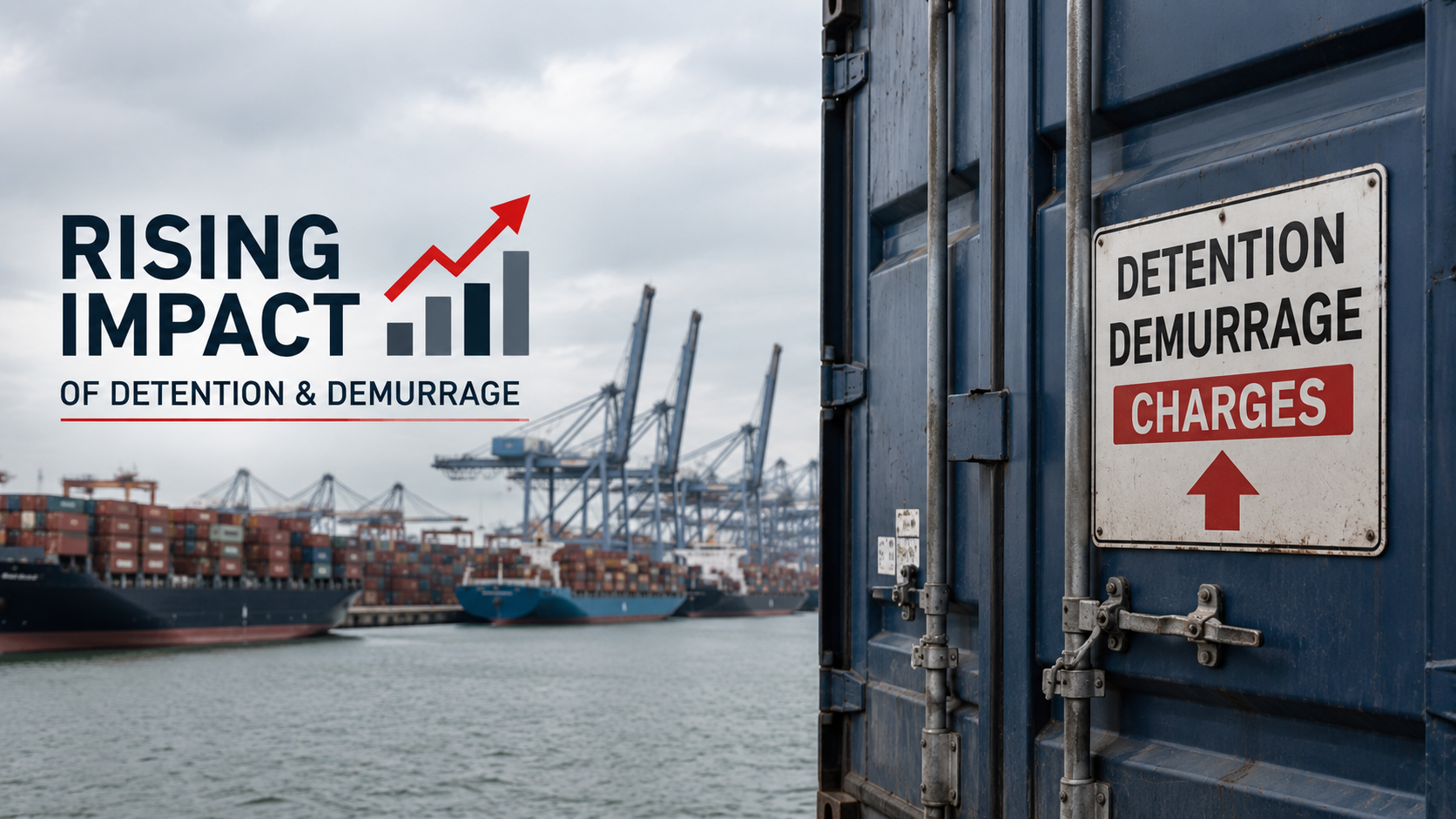
 As regional supply chain bottlenecks and cargo rerouting pressures squeeze free-time windows, detention and demurrage charges remain a complex financial risk threatening logistics margins.
Understanding Detention & Demurrage: The Basics
Demurrage is assessed when a loaded container remains on port terminal grounds past its allotted free-time window.
Detention kicks in when a shipper or consignee holds the physical equipment outside the terminal boundaries beyond the agreed duration.
In an ideal market context, both billing mechanisms serve to incentivize faster equipment turnover and optimize broader TEU capacity and efficiency. in reality, during periods of acute regional port congestion, these penalty fees regularly pile up regardless of whether the underlying delay is caused by the cargo owner, the inland drayage company, or the ocean carrier.
The Industry Reality:
The global container shipping market processes hundreds of millions of TEUs annually. Fractional increases in terminal dwell times quickly scale minor operational delays into severe, compounding demurrage and detention penalties across primary global logistics corridors.
The Port Congestion Catalysts
The international shipping landscape has been fundamentally reshaped by one of the most severe maritime disruptions in modern history. Following escalating regional military conflict in the Middle East, the critical Strait of Hormuz was effectively closed to commercial traffic. In response, all major ocean carriers—including Maersk, MSC, CMA CGM, and Hapag-Lloyd—abruptly suspended transits through the chokepoint. This rapid, widespread shutdown forced a massive wave of immediate route diversions across global networks, completely fracturing traditional ocean loops with no signs of normalization as the industry scrambles to adapt.
Simultaneously, ongoing attacks on Red Sea shipping resumed, reversing the fragile recovery that had been underway following a period of relative regional calm. For the first time in modern history, both of the Middle East's two major maritime corridors are simultaneously blocked. Vessels have been forced to reroute around Africa's Cape of Good Hope — adding 10 to 14 additional transit days per voyage on Asia–Europe and Asia–U.S. East Coast routes, and boosting fuel consumption by nearly 40%.
This has created highly uneven, regionalized bottlenecks at transshipment hubs that were not designed to absorb sudden vessel clustering at this scale. In Southeast Asia, Manila's main terminals have been operating under sustained heavy yard loads, with average berthing wait times of two to three days and yard utilization running between 85–90% across both Manila North and South terminals, severely constraining operational throughput. When large vessel clusters arrive simultaneously, downstream strain on terminal yards causes free-time windows to exhaust before containerized cargo can be cleared.
What impacts supply chains most is being penalized for delays completely out of their control — whether it's closed port gates, sudden terminal yard capacity blocks, or irregular vessel scheduling.
Container Types Most at Risk
Not all maritime equipment is equally exposed to detention and demurrage risks. The nature of the cargo, specialized machinery requirements, and strict regulatory handling mandates heavily dictate how fast daily penalty tiers escalate.
Reefer containers (Risk Level: Very High) — Mandatory cold-chain power connection requirements and strict timeline constraints make these the most exposure-prone equipment type.
ISO tank containers (Risk Level: High) — Required cleaning, strict validation, and hazardous cargo protocols extend dwell times and increase penalty exposure.
High cube containers — 40'HC / 45'HC (Risk Level: Medium–High) — High absolute volume exposure and dimensional clearance constraints at crowded yards compound risk.
Flat rack containers (Risk Level: High) — Out-of-gauge handling requires specialized terminal stacking footprints, limiting flexibility during congestion peaks.
Open top containers (Risk Level: Medium) — Top-loading crane scheduling constraints create compounding delays during extreme port backlogs.
Standard 20' / 40' dry (Risk Level: Medium) — Massive absolute volume exposure creates systemic risk despite lower standard base tariff rates per unit.
Digitization and Visibility: The Proactive Defense
In a volatile logistics landscape, relying on reactive spreadsheet tracking or manually checking individual carrier portals leaves supply chains exposed to surprise penalties. Advanced container tracking and monitoring technology has transformed from a premium operational preference into an economic necessity.
Real-time visibility tools track specific operational milestones — such as container discharge, terminal gate events, and actual container availability dates. By automatically tracking last-free-day countdowns, logistics teams can spot documentation delays, customs holds, or drayage gaps well before free time lapses. This allows resources to be redirected toward high-priority containers before penalties mount.
Leasing vs. Buying: Strategic Equipment Structures
Equipment procurement strategy plays a critical role in managing risk. Operating a rigid, entirely self-owned container fleet means bearing the full financial weight of equipment sitting idle during extended terminal bottlenecks.
Utilizing flexible shipping container leasing models provides a valuable operational safety valve. Scaling container procurement to real-time trade volumes and utilizing short-term lease options allows businesses to return equipment promptly once stripped, shifting return liabilities away from congested zones and reducing idle asset exposure.
Conclusion: Turning Vulnerability Into Operational Resilience
Detention and demurrage charges are no longer just routine line items to be absorbed passively under the cost of doing business. They represent a sharp financial filter that separates reactive supply chains from highly adaptive ones. As global rerouting patterns continue to exert unprecedented pressure on transshipment nodes — driven by the simultaneous closure of the Strait of Hormuz and the Red Sea corridor amid ongoing regional instability — unexpected spikes in terminal yard dwell times will remain an operational reality for the foreseeable future.
VS&B Containers Group delivers agile, end-to-end maritime equipment solutions — spanning flexible container leasing, global buying and selling, and expert container asset management. Backed by decades of logistics expertise, our teams provide the operational flexibility and market intelligence required to minimize D&D exposure and navigate shifting port dynamics with confidence.
VS&B Containers group offers both standard and custom-made containers, delivered directly from the factory to your desired location. With a fleet of over 25,000 containers made available across Asia, Europe, US and Australia, the company helps customers get containers effortlessly from anywhere in the world. If you have unique needs in terms of affordability, adaptability, and potential return on investment, please drop an email to traders@vsnb.com, and the VS&B team will contact you to discuss further.
- Log in to post comments