
What Happens to a Shipping Container After It Falls into the Ocean?
Somewhere beneath the ocean right now, tens of thousands of steel boxes are sitting on the seafloor. Some are full of sneakers. Some hold furniture. Some hold cars. And at least one of them held 28,000 rubber ducks - toys that are still washing up on beaches more than three decades later.
Every year, roughly 250 million containers cross the world's oceans, and almost all of them arrive exactly where they're supposed to. Almost. A small percentage never make it — and what happens to them after they hit the water is stranger, and more consequential, than most people realize.
Floating vs. Sinking: It All Depends on What's Inside
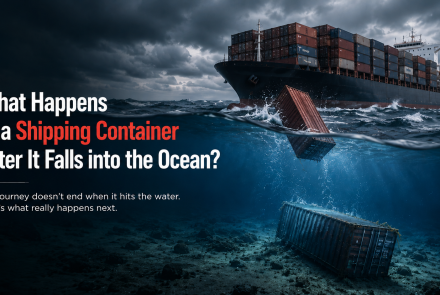
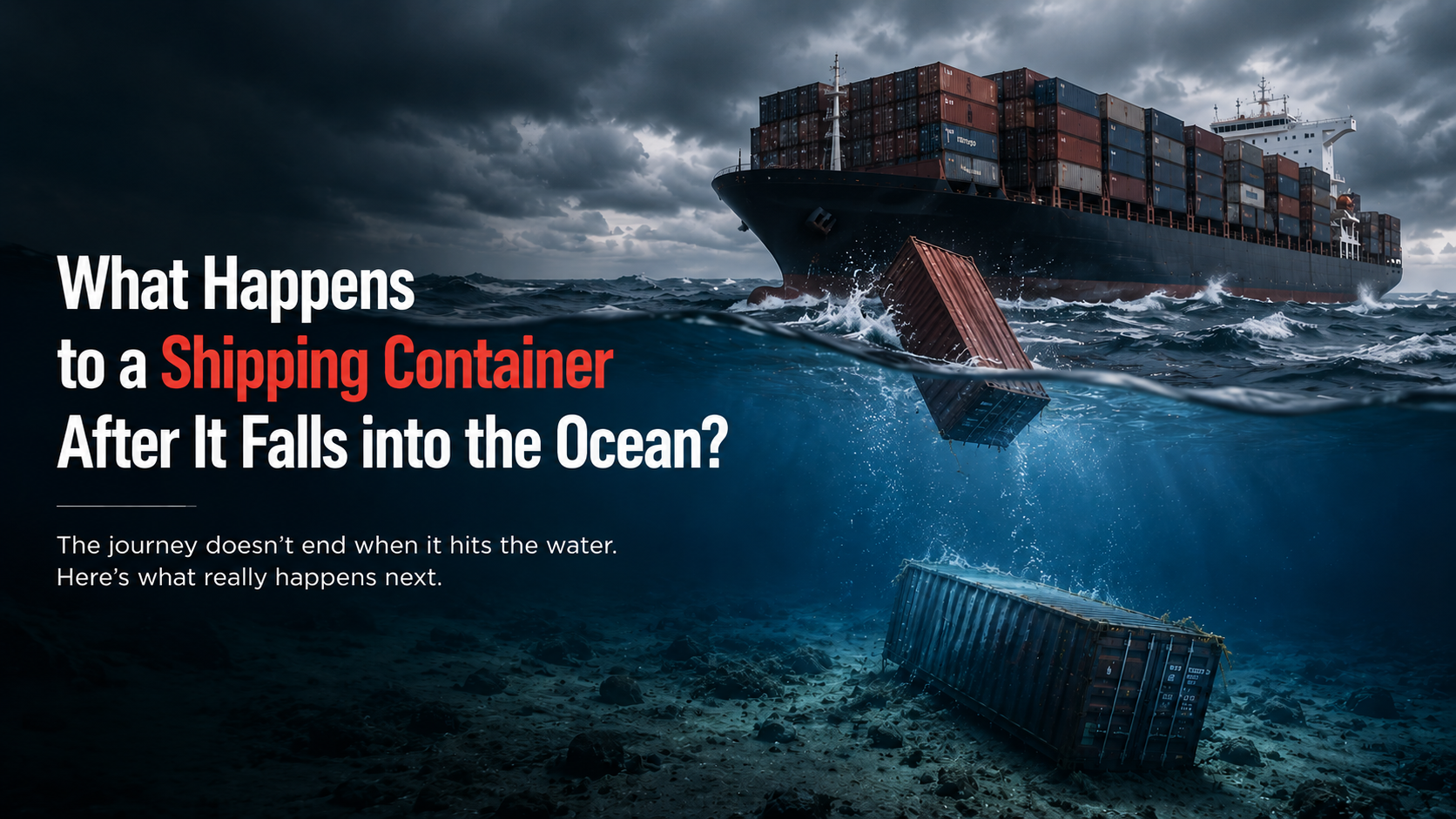
When a container goes over the side of a ship, its fate is decided within seconds — and it comes down entirely to cargo.
A container packed with something dense, like steel pipes, drops straight down. It can fall four or five kilometers before hitting the seafloor at a speed comparable to a car on the highway.
But a container packed with lighter cargo — clothing, toys, packaging foam — behaves completely differently. Because containers are built to be weathertight, a lightly-loaded box doesn't sink right away. It floats. Not visibly on the surface where a passing ship might spot it, but just at or below the waterline, essentially invisible.
That distinction — sink or float — sets up two very different afterlives for lost cargo.
Ghost Containers: The Hazard No One Can See
A semi-submerged container is sometimes called a "ghost container," and it's one of the most feared hazards on the open ocean. A 20-ton steel box drifting just below the surface is invisible at night, invisible in rough seas, and invisible on radar.
For a massive cargo ship, that's a non-event. For a small vessel — a sailboat, a yacht — it can be catastrophic. Boats have been found with their hulls split open with no clear explanation, and long-distance sailors consistently rank drifting containers among the hazards they fear most, precisely because there's no way to see one coming.
A floating container isn't a brief hazard, either. Depending on what's inside, it can stay buoyant for days or even weeks, riding ocean currents for hundreds of kilometers before seawater finally works its way in and the box begins its slow trip to the bottom.
Seafloor Impact: A New Kind of Ecosystem
Once a container reaches the ocean floor, it doesn't just disappear — it becomes something new.
In 2004, a ship called the MOL/Med Taipei lost containers in a storm off the California coast. One of them landed inside the Monterey Bay National Marine Sanctuary — one of the most closely studied stretches of ocean on Earth. Rather than remove it, scientists made an unusual choice: they left it in place and studied it for years, sending robotic submersibles down to document what happened.
The container had crushed everything beneath it on impact. But over time, deep-sea organisms began treating the steel surface like a reef — a rare hard structure in an otherwise soft, muddy seabed. New species moved in, including some that wouldn't normally be found in that part of the ocean at all. That single container became an accidental, decades-long science experiment.
Multiply that by every container that's ever been lost, and the seafloor turns out to be quietly dotted with thousands of these unplanned steel islands — permanent fixtures that will likely remain for centuries.
When Cargo Escapes: The Rubber Ducks, the Sneakers, and the Lego
Not every container stays put. Sometimes the box breaks open before it sinks, and the cargo goes wandering — and a few of these incidents have become some of the most useful (and strangest) events in oceanography.
The 1992 rubber duck spill. A ship crossing the Pacific lost a container holding 28,000 plastic bath toys, including thousands of yellow rubber ducks. The container broke apart, and the ducks scattered across the ocean. They've been washing ashore ever since — in Alaska, in Hawaii, in South America. Some rode currents through the Arctic and eventually turned up on beaches in the Atlantic, on the opposite side of the planet. Oceanographers realized they'd been handed an unplanned but incredibly useful experiment: thousands of floating tracers that helped refine scientific models of how global ocean currents actually move.
The Nike sneaker spill. A similar event happened with a container of Nike shoes, which beachcombers and scientists tracked washing ashore for years, adding more real-world data to the same current-mapping efforts.
The 1997 Lego spill. Off the coast of Cornwall, England, a container spilled nearly 5 million pieces of Lego into the sea. People are still finding individual pieces on those beaches today — and in a detail that's almost too fitting, many of the scattered pieces were ocean-themed: tiny plastic octopuses and dragons, quite literally coming out of the sea decades after they fell in.
Recovery: Why Almost None of This Comes Back
Once a container is lost, actually retrieving it is rare. Containers that sink intact can end up kilometers deep, in locations that are difficult and expensive to pinpoint, let alone reach. Containers that break open scatter their contents across huge distances almost immediately, making recovery effectively impossible. For most lost cargo, the ocean is a one-way trip.
The Environmental Cost
The environmental impact of lost containers is a mixed and lasting picture. On one hand, sunken containers can create artificial reef structures that marine life adapts to use. On the other, that adaptation isn't necessarily positive — species colonizing a steel container are sometimes species that don't belong in that ecosystem at all. And cargo that escapes and floats away, especially anything plastic, becomes long-term ocean debris and marine litter, quietly persisting on coastlines for decades.
The Next Piece of Plastic You See on a Beach
The lifecycle of a lost shipping container is really a story about how much we still don't know about the ocean. A container can sink, drift, become a reef, or break apart and scatter its cargo across multiple oceans and decades — and in nearly every case, no one is tracking exactly where it ends up.
So the next time you're walking along a beach and spot a weathered, unfamiliar piece of plastic at your feet, it's worth a second look. It might not be ordinary litter. It might be a traveler that escaped from a steel box in the middle of the ocean years ago, thousands of kilometers away — finally finishing a journey no one ever planned.
Conclusion
A lost shipping container's story doesn't end the moment it goes overboard — it just changes shape. Some sink and quietly become new seafloor habitats. Some drift for weeks as invisible hazards to other vessels. And some break open entirely, scattering their cargo across oceans and decades, turning up on beaches thousands of kilometers from where they fell.
For an industry built on precision — tracked routes, tight schedules, exact weights and manifests — it's a reminder of how much is still left to chance once cargo leaves the deck. That's exactly why container security and safety and stronger container fleet management practices matter long before a storm ever hits: better lashing, accurate weight declarations, and smarter routing all reduce the odds that a container ever becomes one of these stories in the first place.
At VS&B Containers Group, we think about this lifecycle as part of a bigger picture — one where sustainable container solutions, reliable container tracking and monitoring, and durable, well-maintained equipment aren't just operational details, but the difference between cargo that arrives safely and cargo that ends up as an accidental science experiment on the ocean floor. The ocean will always claim its share. Good practices across the container supply chain are how the industry keeps that share as small as possible.
VS&B Containers group offers both standard and custom-made containers, delivered directly from the factory to your desired location. With a fleet of over 25,000 containers made available across Asia, Europe, US and Australia, the company helps customers get containers effortlessly from anywhere in the world. If you have unique needs in terms of affordability, adaptability, and potential return on investment, please drop an email to traders@vsnb.com, and the VS&B team will contact you to discuss further.
- Log in to post comments